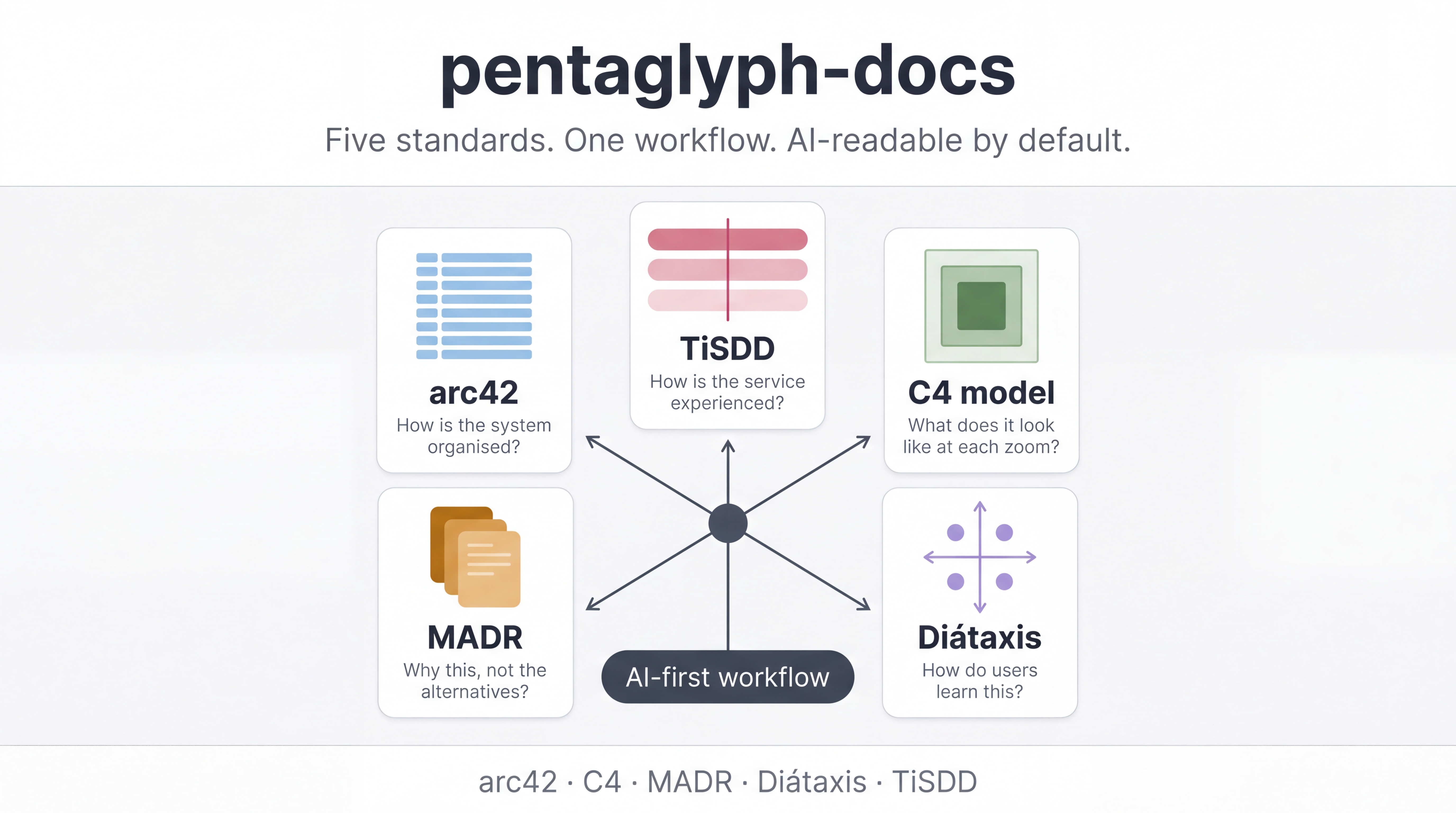
arc42
arc42 is a free, open template for documenting software architectures, created by Dr. Peter Hruschka and Gernot Starke in 2003. It is the de-facto standard for software architecture documentation in the German-speaking IT industry and is used internationally as a vendor-neutral, technology-agnostic structure.
| Authoritative source | https://arc42.org/overview/ |
|---|---|
| Maintainers | Dr. Peter Hruschka, Gernot Starke (Aim42) |
| Local home in the kit | template/docs/arc42/ |
| Slot in pentaglyph | #1 of 5 — the architecture spine |
What problem does arc42 solve?
Section titled “What problem does arc42 solve?”Architecture docs typically suffer one of three failure modes:
- Empty — no architecture doc exists; the design lives only in the heads of senior engineers.
- Bloated — a 200-page Word document nobody reads; updated once at hand-over and never again.
- Improvised — a single
README.mdthat grew topics ad-hoc; no shared structure between projects.
arc42 fixes mode 3 by providing a 12-section template that names every architectural concern once and gives it a fixed home. Sections you don’t need stay empty stubs (the structure itself is informative).
The 12 sections at a glance
Section titled “The 12 sections at a glance”| # | Section | What goes in it |
|---|---|---|
| 1 | Introduction & Goals | What the system does and its 2-3 top-priority quality goals |
| 2 | Constraints | Technical / organisational / political constraints that limit choices |
| 3 | Context & Scope | What systems / actors integrate with this one; what is out of scope |
| 4 | Solution Strategy | The big-picture technical choices and why |
| 5 | Building Blocks | Static decomposition (links into detailed-design/ for L2+) |
| 6 | Runtime View | Sequence diagrams for important scenarios |
| 7 | Deployment View | Where the system actually runs |
| 8 | Crosscutting | Concerns that span modules: security, observability, error model, i18n |
| 9 | Decisions | MADR ADRs — the why behind technical choices |
| 10 | Quality | SLOs, KPIs, performance / reliability targets |
| 11 | Risks | Technical debt, known fragilities |
| 12 | Glossary | Domain vocabulary |
How pentaglyph uses arc42
Section titled “How pentaglyph uses arc42”Pentaglyph maps each of the 12 sections to a directory under template/docs/arc42/:
template/docs/arc42/├── 01-introduction-and-goals/├── 02-architecture-constraints/├── 03-context-and-scope/├── 04-solution-strategy/├── 05-building-blocks/ ← links into ../detailed-design/├── 06-runtime/├── 07-deployment/├── 08-crosscutting/├── 09-decisions/ ← MADR ADRs go here├── 10-quality/├── 11-risks/└── 12-glossary/Pentaglyph adds AI-readable README.md files to each directory so an LLM can decide where to place new content with zero project context.
When to use the full template
Section titled “When to use the full template”- Minimal profile: fill §1 (Goals), §3 (Context), §5 (Building Blocks), §9 (Decisions). Skip the rest until you have a concrete reason to fill them.
- Standard / Full profile: progressively fill more sections as the system grows. arc42 explicitly endorses partial coverage.
When NOT to use arc42
Section titled “When NOT to use arc42”- Single-file scripts or throwaway prototypes — overkill.
- Pure documentation repositories (use Diátaxis directly).
- Codebases that will be deleted in < 3 months.
Authoritative references
Section titled “Authoritative references”- Official site: https://arc42.org/overview/
- Free PDF / Asciidoc / Markdown templates: https://arc42.org/download
- Book (free): arc42 by Example — Gernot Starke & Michael Simons
- Maintainer organisation: Aim42 — for architecture improvement methods
See also
Section titled “See also”- Why five standards — pentaglyph’s rationale for bundling arc42 with the other four
- Template inventory —
1_architecture-overview.mdis the arc42-aligned template - C4 model — the visual notation pentaglyph pairs with arc42 §3, §5, §6