PEL — Project Engagement Layer (binder)
PEL (Project Engagement Layer) is pentaglyph’s sixth slot — but unlike slots 1-5, it is not a peer standard. It is a binder that composes eight well-known client-engagement primitives into one local home, so consulting / advisory practices can keep client-facing artefacts alongside their technical docs.
| What it composes | Eight client-engagement primitives (see below) |
|---|---|
| Why a binder, not a standard | The client-engagement space has no single canonical framework — composing existing primitives is more honest than inventing a sixth peer |
| Local home in the kit | template/docs/client-engagement/ |
| Slot in pentaglyph | #6 (binder) — not a peer standard |
What problem does PEL solve?
Section titled “What problem does PEL solve?”Consulting and advisory practices need to produce client-facing artefacts that don’t fit cleanly into engineering docs:
- Inception decks for kick-offs.
- Weekly status updates for steering committees.
- One-page status reports for executive sponsors.
- Decision documents for RACI / DACI sign-off.
- RAID logs (Risks, Assumptions, Issues, Dependencies).
- Press-release-style product announcements (Amazon-style PR-FAQ).
These artefacts have well-known primitives — each with its own canonical source — but no single industry standard covers all of them. PEL gives them a shared local directory without inventing a new framework.
The eight composed primitives
Section titled “The eight composed primitives”| Primitive | Origin | Use |
|---|---|---|
| Inception Deck | Jonathan Rasmusson, The Agile Samurai (2010) | 10-slide project kick-off |
| GitLab Handbook weekly update | GitLab Handbook | Public weekly progress + blockers |
| Atlassian weekly status | Atlassian Team Playbook | Internal team weekly status template |
| Basecamp Heartbeat | Basecamp / 37signals | Asynchronous milestone update |
| Amazon 6-pager | Amazon internal practice (Bezos 2004 memo) | Six-page narrative document for decision meetings (replaces slides) |
| Now-Next-Later roadmap | ProdPad / Janna Bastow | Goal-based roadmap without dates |
| DACI decision document | Atlassian Team Playbook | Driver / Approver / Contributor / Informed — group decision template |
| RAID log | PMI / PRINCE2 practice | Risks / Assumptions / Issues / Dependencies tracker |
| PR-FAQ | Amazon working-backwards method | Press release + FAQ written before building the product |
(Nine items in the table because PR-FAQ and 6-pager are sometimes counted together — pentaglyph keeps them as separate primitives because the audience differs.)
How pentaglyph uses PEL
Section titled “How pentaglyph uses PEL”template/docs/client-engagement/├── inception-deck/├── weekly-update/ ← GitLab + Atlassian + Basecamp variants├── 6-pager/├── pr-faq/├── now-next-later/├── daci/└── raid/Each subdirectory contains a template + a one-page how-to that links out to the primitive’s authoritative source. Pentaglyph does not re-author the primitives; it just gives them a predictable place to live.
Why “binder” and not “sixth peer standard”?
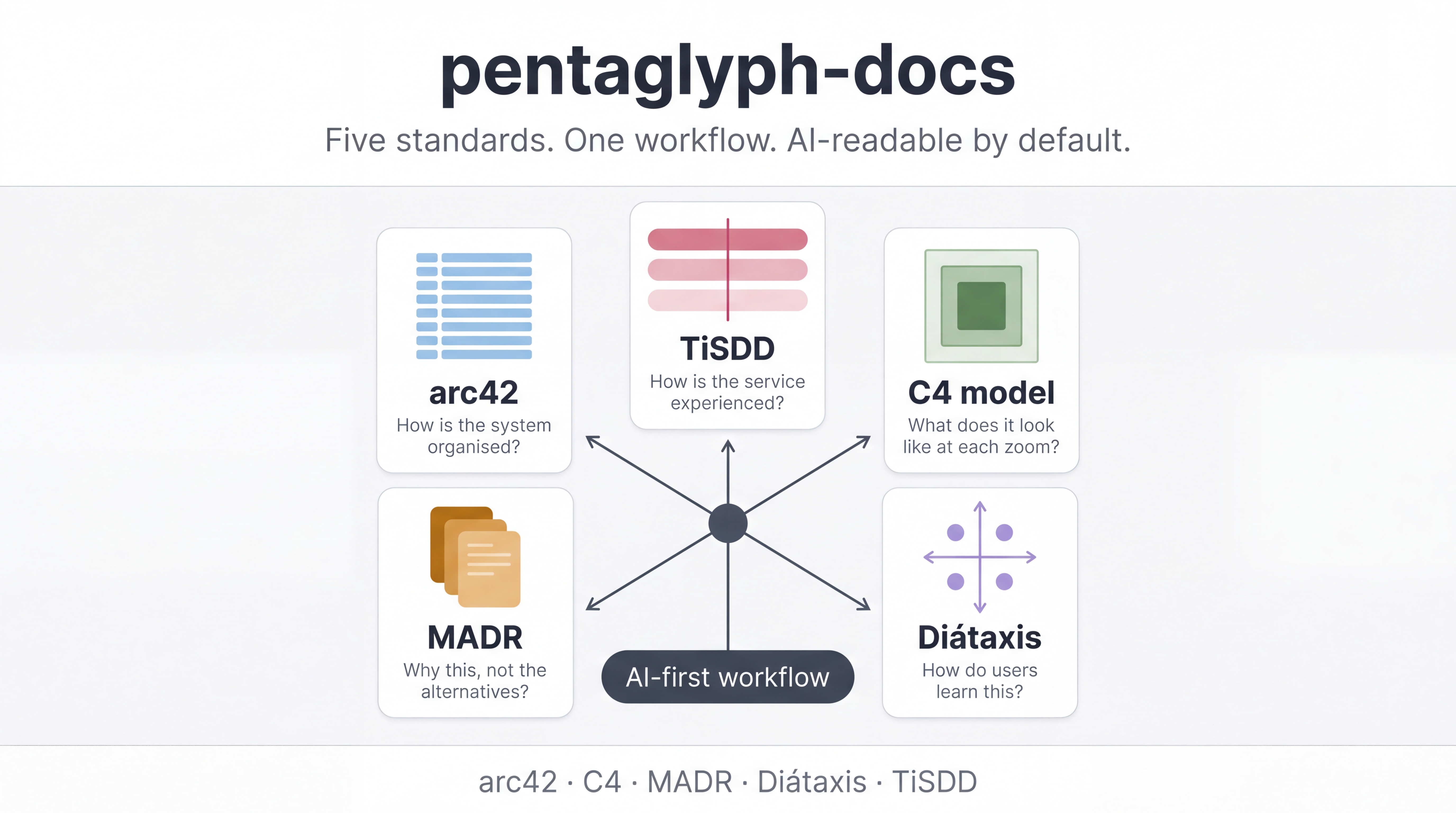
Section titled “Why “binder” and not “sixth peer standard”?”Slots 1-5 (arc42, C4, MADR, Diátaxis, TiSDD) all share three properties:
- A single authoritative source (one URL, one maintainer, one canonical spec).
- Wide industry adoption (each used at dozens of major organisations).
- Decade-stable (none have had breaking changes in 10+ years).
The client-engagement space has none of those. There are dozens of partial frameworks, each maintained by a different vendor (Atlassian / Basecamp / Amazon / GitLab), and the practices shift every few years. Inventing a “sixth peer standard” would mean creating a brittle, opinionated framework — exactly what pentaglyph’s design philosophy avoids.
A binder is honest about this: “here are the primitives we use, here is where they live, the upstream source of each is authoritative.”
When to use PEL
Section titled “When to use PEL”- Consulting / advisory practices — client kick-offs, weekly updates, decision documents.
- Internal teams with executive stakeholders — Amazon 6-pagers and PR-FAQs are useful even inside engineering orgs.
- Cross-functional projects — DACI and RAID for shared decision tracking.
When NOT to use PEL
Section titled “When NOT to use PEL”- Pure internal engineering teams with no external stakeholders or executive reporting.
- Single-developer projects.
Authoritative references (per primitive)
Section titled “Authoritative references (per primitive)”- Inception Deck: https://pragprog.com/titles/jtrap/the-agile-samurai/
- GitLab Handbook: https://handbook.gitlab.com
- Atlassian Team Playbook: https://www.atlassian.com/team-playbook
- Basecamp Handbook: https://basecamp.com/handbook
- Amazon 6-pager: see Brad Porter’s blog post (no official Amazon doc)
- Now-Next-Later: https://www.prodpad.com/blog/the-now-next-later-roadmap/
- DACI: https://www.atlassian.com/team-playbook/plays/daci
- RAID logs: PMI / PRINCE2 — no single canonical source
- PR-FAQ: see Ian McAllister’s How does Amazon’s PR-FAQ work? (no official Amazon doc)
See also
Section titled “See also”- Why five standards — why PEL is a binder, not a peer
- What is pentaglyph — pentaglyph’s overall composition