MADR v3.0
MADR (Markdown Architecture Decision Records) is a community-maintained ADR template that distills the original 2011 Michael Nygard ADR pattern into a tighter, Markdown-friendly form. Version 3.0 is the current stable spec.
| Authoritative source | https://adr.github.io/madr/ |
|---|---|
| Maintainer | The ADR community (GitHub: adr/madr) |
| Local home in the kit | template/docs/arc42/09-decisions/ |
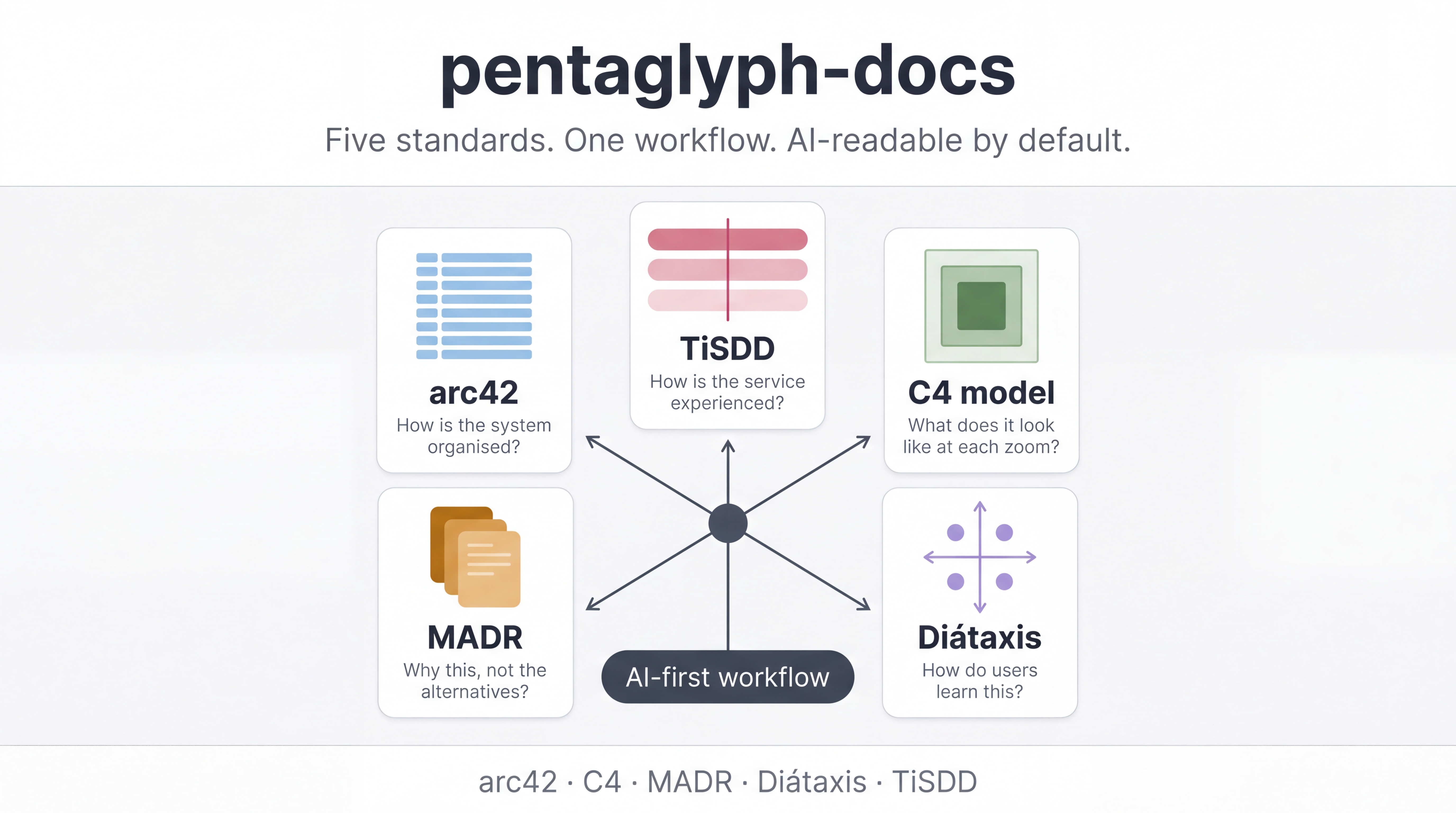
| Slot in pentaglyph | #3 of 5 — the decision layer |
What problem does MADR solve?
Section titled “What problem does MADR solve?”Without a decision record, every architectural choice has the same failure pattern:
- Decision made on a call. No notes.
- Six months later, someone asks “why did we choose X again?”
- Nobody remembers. The argument is re-litigated from scratch.
- The team either re-converges on the same answer (wasted hours) or accidentally picks a different one (silent inconsistency).
ADRs break this loop. One decision, one file, one date, immutable once accepted. Six months later, the answer is grep-able.
The MADR v3.0 structure
Section titled “The MADR v3.0 structure”A MADR file has these sections:
# <Title — verb phrase, not a noun>
* Status: Proposed | Accepted | Rejected | Superseded by ADR-NNNN* Date: YYYY-MM-DD* Deciders: [list of names]
## Context and Problem Statement[2-4 sentences: forcing function + decision space]
## Decision Drivers* driver 1* driver 2
## Considered Options* Option A* Option B* Option C
## Decision OutcomeChosen option: "Option B", because [justification].
### Consequences* Good: [positive outcomes]* Bad: [costs accepted]
## Pros and Cons of the Options[per-option deep dive]
The Considered Options + per-option pros/cons section is what distinguishes MADR from Nygard’s original — it forces you to name and justify the alternatives, not just the chosen option.
How pentaglyph uses MADR
Section titled “How pentaglyph uses MADR”template/docs/arc42/09-decisions/├── 0000-template.md├── 0001-<title>.md├── 0002-<title>.md└── ...Rules:
- One ADR per file. Filename:
NNNN-<kebab-title>.md, sequential 4-digit numbering, no gaps. - Status starts at
Proposed. BecomesAcceptedonly after team review. Acceptedbodies are immutable. Supersede with a new ADR; never edit history.- Cross-link related ADRs (
Supersedes: 0007/Superseded by: 0042).
See How to write an ADR for the operational deep dive.
When to write an ADR
Section titled “When to write an ADR”Write one if:
- The decision has named alternatives that someone else would seriously consider.
- The decision has non-obvious trade-offs.
- Six months from now someone might ask “why X instead of Y?”
- The decision affects more than one module.
Do not write an ADR for variable names, formatting, or “use library X” when there were no real alternatives.
MADR vs. other ADR formats
Section titled “MADR vs. other ADR formats”| Format | Year | Distinguishing feature |
|---|---|---|
| MADR v3.0 | 2024 | Required Considered Options + per-option pros/cons |
| Nygard original | 2011 | Minimal: Context / Decision / Status / Consequences |
| Y-statements | 2018 | One-sentence ADRs (Zimmermann) |
| arc42 §9 native | — | Just a section; no fixed shape |
Pentaglyph picks MADR v3.0 because it forces the most rigorous Alternatives discipline without becoming a mini design doc.
Authoritative references
Section titled “Authoritative references”- Official site: https://adr.github.io/madr/
- GitHub repo: https://github.com/adr/madr
- Michael Nygard’s original essay (2011): https://www.cognitect.com/blog/2011/11/15/documenting-architecture-decisions
- Y-statements (Olaf Zimmermann): https://medium.com/olzzio/y-statements-10eb07b5a177
See also
Section titled “See also”- How to write an ADR — the operational guide
- Choose the right template — ADR vs Module DD
- arc42 — MADR lives in arc42 §9 in pentaglyph