TiSDD
TiSDD (This Is Service Design Doing, 2018) is the canonical reference book and method bank for service design, authored by Marc Stickdorn, Markus Hormeß, Adam Lawrence, and Jakob Schneider. It documents ~50 service-design methods (personas, customer journeys, service blueprints, co-creation workshops, etc.) with case studies from organisations including Adobe, Lufthansa, and the UK Government Digital Service.
| Authoritative source | https://www.thisisservicedesigndoing.com/methods |
|---|---|
| Authors | Stickdorn, Hormeß, Lawrence, Schneider |
| Local home in the kit | template/docs/service-design/ |
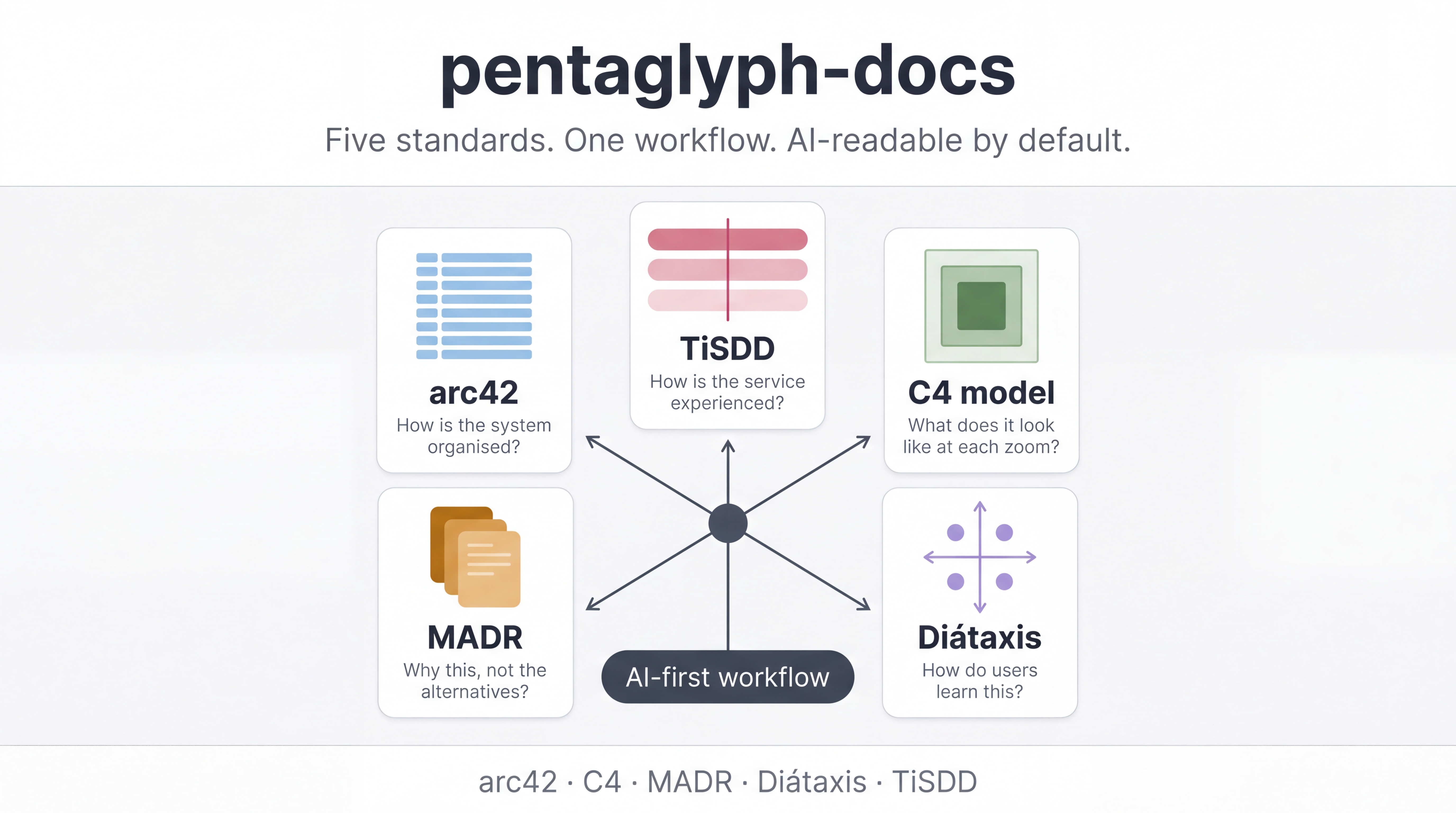
| Slot in pentaglyph | #5 of 5 — the service-design layer |
What problem does TiSDD solve?
Section titled “What problem does TiSDD solve?”Most software-architecture documentation kits (including pentaglyph until 2026) skip a layer that becomes critical the moment your product has actual users:
- Who are these users, concretely? Not “developers” — which developers, with what goals, in what context?
- What journey are they on? Not “use the API” — what step-by-step experience leads to value?
- What’s happening backstage when they touch the product? Not “the backend processes the request” — what humans, systems, and policies are involved?
These are service-design questions, and pentaglyph deliberately did not invent its own answers. Instead, TiSDD is bound as the upstream canon.
The three core artefacts pentaglyph uses
Section titled “The three core artefacts pentaglyph uses”Personas — who is this for?
Section titled “Personas — who is this for?”A persona names a specific user archetype with goals, context, and constraints. Not demographics — decision-relevant attributes.
“Maya, senior backend engineer, 8 years experience, evaluating new doc kits during her team’s quarterly tech-debt sprint. Decides on tooling for a 12-person team. Will reject anything that takes more than 30 min to evaluate.”
Pentaglyph template: 6_persona.md. Lives under service-design/personas/.
Journey maps — how do they experience this?
Section titled “Journey maps — how do they experience this?”A journey map walks one persona through the stages of an experience, showing what they think / feel / do at each stage. Identifies friction points.
Pentaglyph template: 7_journey-map.md. Lives under service-design/journeys/.
Service blueprints — what happens frontstage and backstage?
Section titled “Service blueprints — what happens frontstage and backstage?”A service blueprint maps the user-visible frontstage journey to the backstage systems, humans, and processes that produce it. Reveals where customer-facing failures originate in invisible backend issues.
Pentaglyph template: 8_service-blueprint.md. Lives under service-design/blueprints/.
Why TiSDD instead of an alternative?
Section titled “Why TiSDD instead of an alternative?”Several service-design canons exist. TiSDD was chosen because:
- Authoritative book + free method bank — the methods site is free and exhaustive.
- Active community — workshops, certifications, and a maintained method library.
- Tool-neutral — TiSDD describes the methods, not which Figma / Miro / Mural template to use. Aligns with pentaglyph’s domain-neutrality philosophy.
- Industry adoption — used at Adobe, Lufthansa, GDS, and other large product organisations.
How pentaglyph uses TiSDD
Section titled “How pentaglyph uses TiSDD”template/docs/service-design/├── personas/ ← Template 6├── journeys/ ← Template 7└── blueprints/ ← Template 8Note:
service-design/is opt-in via--include=service-design. Not installed by default inminimal/standard/fullprofiles, because many engineering teams don’t need it. Most useful for customer-facing product teams and regulated industries with explicit user-experience requirements.
When to use TiSDD
Section titled “When to use TiSDD”- Customer-facing product teams (B2C, B2B SaaS with real onboarding journeys).
- Regulated industries where user experience must be documented for audit (healthcare, finance).
- Any team where the question “who is this for, and how do they experience it?” is non-trivial.
When NOT to use TiSDD
Section titled “When NOT to use TiSDD”- Internal libraries and developer tools — the persona is usually obvious (yourself + 2 colleagues).
- Throwaway prototypes.
- Codebases with no user-facing surface.
History in pentaglyph
Section titled “History in pentaglyph”The original pentaglyph predecessor (named tetragram) had four standards: arc42 + C4 + MADR + Diátaxis. In 2026, TiSDD was added as the fifth peer standard when service design became necessary for several downstream consumers building customer-facing platforms. The rename from tetragram (four) to pentaglyph (five) reflects this expansion.
Authoritative references
Section titled “Authoritative references”- Official method bank: https://www.thisisservicedesigndoing.com/methods
- Book: This Is Service Design Doing (Stickdorn et al., O’Reilly 2018) — ISBN 978-1491927182
- Predecessor book: This Is Service Design Thinking (Stickdorn & Schneider, 2010) — still useful as background
- Service Design Network: https://www.service-design-network.org
See also
Section titled “See also”- Why five standards — why TiSDD was added as the fifth
- Template inventory — Templates 6-8 are TiSDD-aligned
- PEL (binder) — the sixth slot, which composes client-engagement primitives